How do I know if tree roots have gotten into my sewer line?
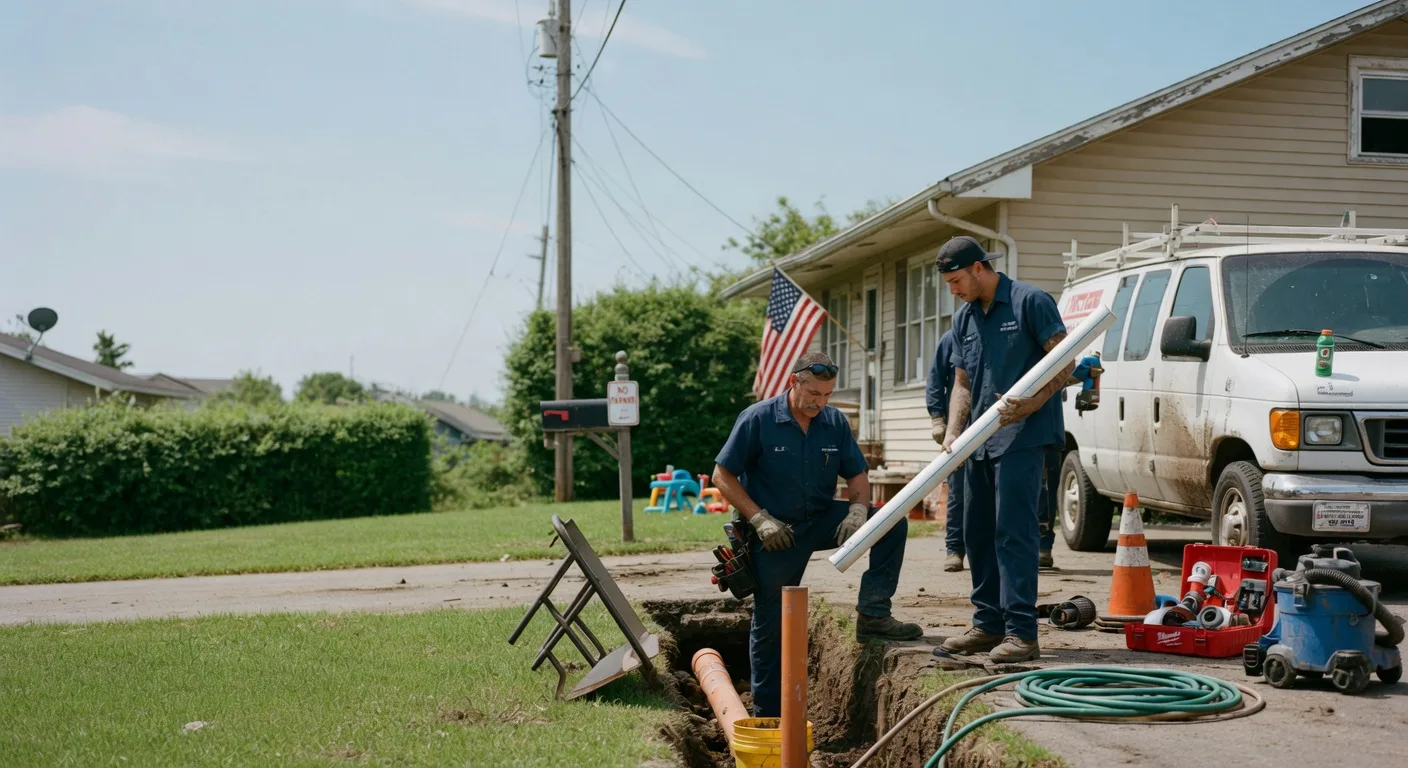
Tree roots get into a sewer line through a hairline crack or a loose joint. Clay pipe is the usual victim because it is laid in short sections, so there is a joint every few feet for a root tip to find. Roots follow moisture, so a strand enters, thickens, and starts catching paper and grease until flow stops. Warning signs are a main line that clogs on a predictable schedule, gurgling from drains near large trees, and a cable machine that keeps stopping at the same distance. One slow fixture is rarely roots. Several drains slowing together, or a basement floor drain that rises, points to the main line where roots live. A cable with a cutting head opens a channel through the mass for temporary relief, and hydro jetting scours the pipe wall more completely, but neither seals the entry point, so the roots return. A camera inspection shows the crack or joint, how much root is present, and the pipe's condition, which decides whether periodic cutting is enough or a section needs repair. Access and the length of pipe involved drive that cost. PVC resists root entry far better than clay. For a suspected root problem in Cooksville, IL, Expert Plumbers Co connects you with an independent local plumber.
Prevention around trees is worth knowing about, because the root itself is rarely the whole story. Not every tree is a threat, and removing one is rarely the right first step, since the roots already in the pipe do not stop growing and the pipe's joints stay open. Willows, maples, poplars, and similar fast growers tend to be the worst for seeking out sewer lines, but any large tree in a dry spell can send roots to a pipe that holds moisture. Avoid pouring rock salt or copper sulfate products into toilets without asking a plumber first, since they can harm pipe and the wider water system. Keep records of when the line was last cut or jetted. If the intervals between clogs are getting shorter, that is a sign the root mass is thickening and a repair may soon be better value than repeated cleaning. Ask the plumber about replacement options.
My bathroom sink drains slowly but the stopper is clean. What else could it be?
If you have pulled the stopper and cleaned off the hair and soap film and the sink still drains slowly, the restriction is further down. The stopper mechanism is only the first few inches. Most of the slowdown lives in the pivot rod area, the tailpiece, the trap, or the pipe beyond it.
The common cause is a layer of soap scum, toothpaste and hair that binds together on the pipe wall. It narrows the pipe a little each month, and the sink slows long before it stops.
Safe checks you can do: set a bucket under the sink and unscrew the trap. Clear out what you find and rinse it. Look at the short pipe going into the wall for build-up you can reach with a bottle brush. Fill the basin and let it run, then watch whether the water drains evenly or with a gurgle. Skip chemical cleaners, which can soften plastic fittings and leave caustic liquid sitting in the trap.
Gurgling is a clue. A sink that drains slowly and gurgles can point to a blocked vent, because the drain cannot pull air behind the water. If the toilet or shower near that sink also acts up, the blockage may be in the shared branch line or the main drain, not the sink itself.
One slow sink with everything else normal usually means a local clog, and a cable machine through the trap arm is enough. If the pipe clears and slows again within a few weeks, a camera inspection can show whether the pipe wall is scaled over or has a sag that holds water. Heavy scale or soap buildup in the branch line may call for hydro jetting.
Call and stop using the sink if you see water leaking from the trap or the wall, if sewage smells from the drain, or if several drains in the house slow at once. That pattern usually means the main line is partly blocked.
Cost depends on how easy the pipe is to reach, whether the cleanout is nearby, how far the plumber must run the cable, and whether any worn pipe has to be replaced.
Expert Plumbers Co can connect you with an independent local plumber in Cooksville, IL when you call (380) 262-9173.
There is a soggy strip, a sinkhole or an unusually green line of grass over where my sewer runs. Is that a broken sewer line?
It can be. A wet strip, a dip in the lawn or a stripe of grass that is greener than the rest, all following the path of the sewer, is a classic sign that the pipe is leaking into the soil. Waste water carries nutrients, so the grass above it grows lush while the ground underneath stays soggy.
A sinkhole is more serious. If soil is washing into a cracked or separated pipe, it leaves a void that grows over time. The surface may look fine until the roof of that void gives way. Keep people, pets and vehicles off the area and do not fill it yourself with a quick load of dirt, because the hole will usually return.
Other things can look similar, so check before assuming. A leaking irrigation line, a broken water supply pipe or a downspout discharging at that spot can all soak a strip of lawn. A simple test: shut off every tap and appliance, then look at your water meter. If it keeps moving, the leak is likely on the supply side, not the sewer. If the meter is still, and you also notice slow drains, gurgling, a sewage smell outdoors or backups, the sewer is the stronger suspect.
Safe checks you can do:
Note where the wet or green strip runs and whether it lines up with the cleanout or the path to the street. Reduce water use until the line is looked at.
Stop running water and call now if sewage is surfacing, a hole is opening, or drains inside the house are backing up.
Cleaning alone does not fix a broken pipe. A camera inspection is how a plumber finds the break, shows how far the damage runs and tells whether the pipe is cracked, offset at a joint or collapsed. Repair can then be a spot repair, a liner through the existing pipe, or replacement of a section. Cost is driven by depth, length of pipe affected, what sits on top of it such as a driveway, trees or a patio, how much has to be excavated, the pipe material and permits under local code. To be connected with an independent local plumber in Cooksville, IL, call Expert Plumbers Co on (380) 262-9173.
My sink gurgles after it drains and someone mentioned an air admittance valve. What is that, and can it fail?
"My sink gurgles after it drains" is one of the most common things people notice before a drain problem gets worse. Every fixture needs a vent so water leaving the trap does not pull a vacuum. When air cannot get in, it gets dragged through the trap water instead, and that is the gurgle.
An air admittance valve, or AAV, is a small one-way valve fitted on a vent pipe, often under a sink or in an attic. It opens to let air in as water drains, then drops shut so sewer gas stays in the pipe. Many local codes allow them and some do not, so rules vary by area.
Yes, they can fail. The rubber seal wears, dust or debris stops the flap seating, or the valve sticks. A valve that will not open brings back the gurgling and slow draining. One that will not close lets a sewer smell into the cabinet or room.
A blocked vent stack on the roof, a partial clog in the drain, or a bellied line holding water can also cause gurgling. One gurgling fixture usually points to its own trap, branch line or vent. If the tub, toilet and floor drain all gurgle together, or the toilet bubbles when the washer empties, suspect the main line or the main vent.
Safe homeowner check: Run just the gurgling sink and listen, then run another fixture and see if it does the same. Do not pry at vent parts inside walls, and do not pour drain chemicals into a line that is already gurgling.
Stop running water and call now if sewage smell is strong, water comes up in a tub, shower or floor drain when you use another fixture, a toilet bubbles or rises, or any fixture stops draining.
A cable machine is usually enough for a clog in a single branch line, like the pipe behind one sink. If the gurgle returns, or several fixtures are affected, the plumber may want a camera inspection to look for root intrusion at a clay joint, a bellied line, or a failing section. A blocked roof vent is cleared from the roof, not with a drain cable.
Expert Plumbers Co is a referral service. We connect you with an independent local plumber in Cooksville, IL. Call (380) 262-9173.
Ask the plumber whether an AAV is permitted where you live, or whether a conventional vent is needed instead. Cost depends on access to the pipe, the parts or materials needed, how much wall or ceiling has to be opened, and any permit or code requirement.
I opened the cleanout and it is full of water. Which side of the cleanout is the blockage on?
You pulled the cap on the cleanout and instead of an empty pipe you are looking at standing water. That tells you something useful. Water sitting in an open cleanout means the blockage is downstream of it, toward the street. The pipe is backed up behind the stoppage, and the cleanout is just a window into it.
The reverse also holds. If the cleanout is dry and you still have backups inside the house, the blockage is upstream, between the cleanout and your fixtures.
The usual causes of a full cleanout are root intrusion at a clay joint, a bellied line that holds water and solids, grease build-up on the pipe wall, or a failed sewer lateral where the pipe has collapsed or shifted. Water that holds steady and drains slowly suggests a partial blockage. Water that rises when someone flushes suggests a full one.
One slow fixture is usually a problem in its own branch line. When every drain in the house is slow, gurgling or backing up, especially the lowest tub or floor drain, the main line is the problem. Gurgling at several fixtures can also mean a blocked vent stack, so mention it to the plumber.
Safe homeowner check: Stop using water in the house. Look at the water level in the cleanout without touching the cap again. Note whether it is rising, falling or steady, and which fixtures backed up first. Keep children and pets away from the area.
Stop running water and call now if sewage is coming up in a shower, tub or floor drain, if the cleanout water is rising, or if you smell sewage indoors. Never loosen a cleanout cap under pressure, because sewage can surge out with force. Do not flush or run the washer while you wait.
A cable machine is often enough for a soft stoppage such as paper, grease or roots in an otherwise sound pipe. Hydro jetting is the better tool when grease or scale coats the pipe wall and a cable only punches a hole through it. A camera inspection is the right step when the blockage keeps coming back, when water stands in the line, or when a bellied or broken pipe is likely.
Expert Plumbers Co is a referral service. We connect you with an independent local plumber in Cooksville, IL. Call (380) 262-9173.
Tell the plumber the cleanout is full and where it sits. Ask whether they will run a camera after clearing the line and show you the footage. The scope depends on access to the cleanout, how deep the blockage is, whether the pipe is damaged, and whether a repair means digging or a permit.